

Vancouver is home to some of the most distinctive and historically significant buildings in Canada. From early 20th-century hotels and office towers to striking Art Deco landmarks, the city’s architecture tells the story of how Vancouver grew, rebuilt, and reimagined itself over time.
This guide highlights some of Vancouver’s most interesting historic buildings from the 1900s through the 1950s, focusing on architectural style, historical context, and why these structures still matter today. Whether you’re interested in Vancouver architecture history or simply curious about iconic buildings you can still see around the city, these landmarks offer a fascinating glimpse into Vancouver’s past.
1900–1910: The Hotel Europe

In June 1886, Vancouver was struck by one of the most catastrophic events in its history: the Vancouver Great Fire. Almost 90% of the buildings in town burned down to their grounds, causing many casualties and leaving many families without shelter. Even the famous Gassy Jack’s pub was totally destroyed by the flames.
The city faced a $1.3 million dollar loss, so when the time of reconstruction came, the city council decided that the entirety of Vancouver had to be rebuilt using fireproof materials like bricks.
It was during this period that Angelo Calori, an Italian immigrant, decided to open one of the first hotels in town: the Hotel Europe. Construction began in 1908 and terminated in 1909, making Hotel Europe one of the first hotels in Western Canada to have running water, electricity, and a completely fireproof structure.
The hotel was eventually bought by the city of Vancouver in 1983 and converted to an apartment complex for low-income residents. This structure is heavily inspired by the world-famous Fuller Building (also known as the Flatiron) in New York City, with its Renaissance Revival architectural style.
Today, the Hotel Europe still stands where it was originally built more than 115 years ago and remains one of the most iconic buildings in Gastown, though it cannot be visited.
1910–1920: The Seymour Building
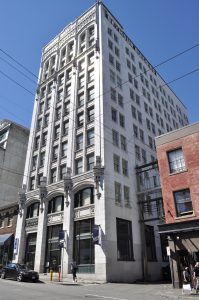
The Yorkshire Guarantee and Securities Corporation Ltd Building, later known as the Seymour Building, was built in 1912 and completed in 1919 due to delays caused by WWI. It still exists today as one of the last Neo-Gothic edifices remaining in Vancouver.
Designed by the Vancouver-based firm of Somervell & Putnam, the distinctive 10-storey granite-faced office tower stands at 525 Seymour Street in the heart of downtown Vancouver. With its 10 floors, the Yorkshire Building was once planned to be the tallest in the city but was surpassed by the Sun Tower in 1912, more than seven years before its completion.
Its elaborate granite facade was a symbol of progress and gave the whole downtown area a fresh and modern look. Today, the building is leased out as office space and has changed hands numerous times over its long lifetime. The careful restoration and upkeep of the exterior and interior heritage details are a major selling point for those looking to rent unique space for their business.
The Seymour Building is a handsome structure that stands as a testament to timeless design and fine detail work in a city with a modern cityscape made of steel and glass.
1920–1930: The Marine Building

The Marine Building is considered one of the most exquisite examples of Art Deco architecture today. This 22-storey construction is recognized by many as one of the most well-preserved and significant edifices from the 1920s.
Its story goes back to the 1910s, when the Panama Canal was officially opened, making it possible to travel between the Atlantic and Pacific Oceans. The opening of the canal made Vancouver one of the busiest and richest harbours in North America, attracting investors from all over Canada, including J.W. Hobbs.
Hobbs was fascinated by the elegance of the Fisher Building in Detroit and believed that Vancouver needed a building of the same league and style. He hired the architecture firm McCartner Nairne and Partners and invested $2.2 million into the project. Construction began in 1929 and ended in 1930 during the Great Depression, which condemned the building to remain mostly empty.
They even built an observation deck on the top, but nobody during those times could afford the 25-cent admission ticket. Due to the terrible economic recession, Hobbs found himself in debt and sold the building for $900,000 to the Guinness family of Ireland to repay his creditors.
Despite this difficult start, the building today has been assessed to be worth more than $90 million, and its beautiful hall is still open to everybody to enjoy.
